
Reconcile carrier invoices against a bill rebuilt from your own CDRs
ADAM reconciles call detail record (CDR) files, vendor rate decks and interconnect invoices. It rebuilds an independent bill from your own traffic, compares the vendor invoice against it per vendor and billing period, and runs a separate rate check that measures contracted against realised rates for each destination and route.
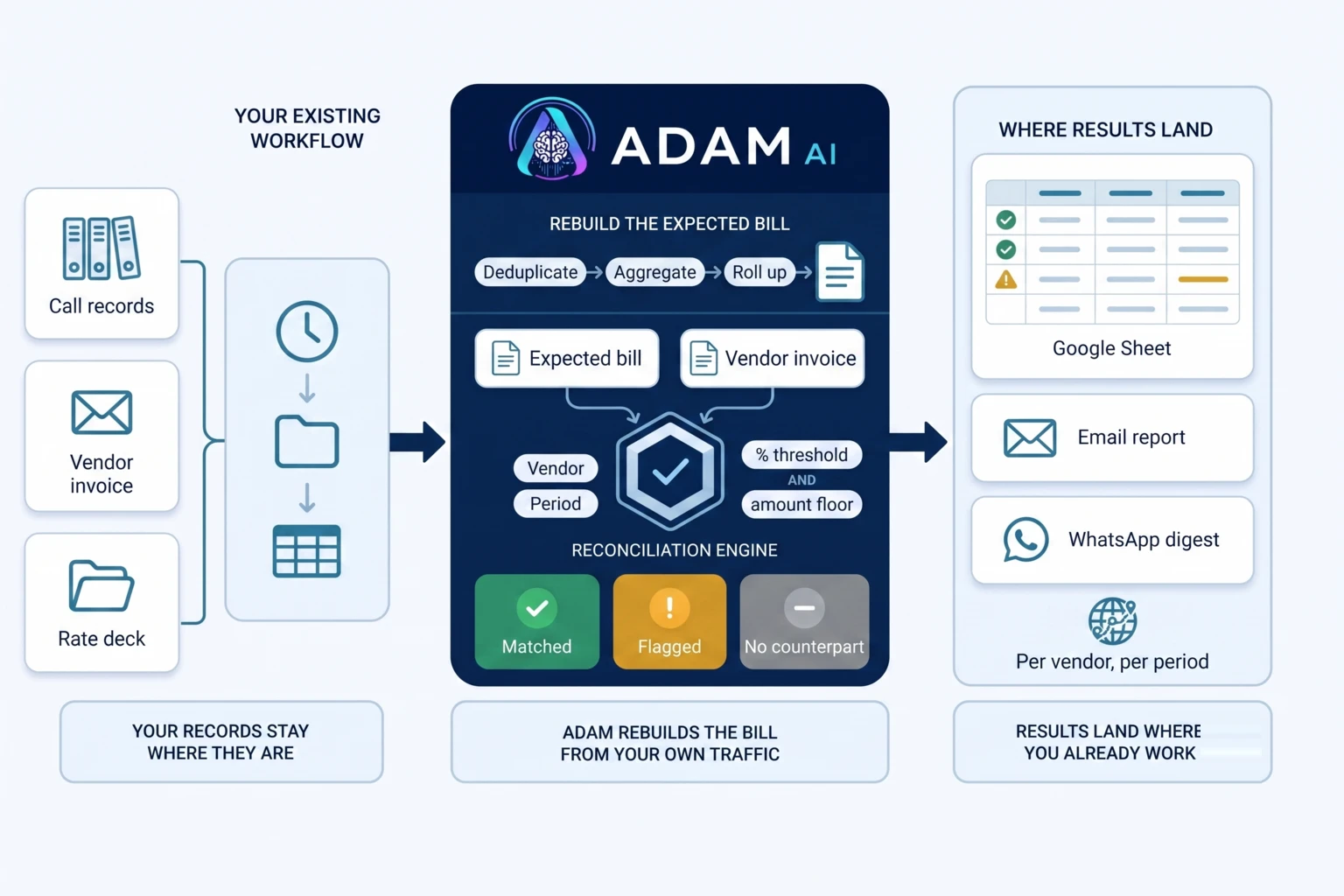
How ADAM turns traffic into an invoice check
The workflow does not treat the invoice as the source of truth. It cleans the call stream first, calculates what the traffic supports, and then runs a separate test of contracted versus realised rates. That order keeps a repeated CDR row from contaminating both the amount comparison and the destination review.
Receive each evidence stream on its own schedule
Hourly CDR files arrive through a secure file drop, rate decks and vendor call records arrive in a shared cloud folder, and invoices arrive by email. ADAM brings those inputs into one reconciliation flow.
Deduplicate calls before aggregating traffic
The same call can reappear across consecutive hourly files. ADAM streams the records and deduplicates them by call reference before any minutes or amounts are added together.
Rebuild the expected bill from the traffic
ADAM groups the clean calls per vendor account and jurisdiction into a daily expected bill, calculated from the traffic rather than copied from the amount on the vendor invoice.
Match invoices and test realised rates
The invoice is matched to that expected bill per vendor and billing period, on period overlap and amount. A separate rate check compares contracted and realised rates for each destination and route, so a local variance stays visible.
A useful dispute needs two thresholds, not one
ADAM turns a discrepancy into a dispute only when a percentage threshold and an absolute monetary floor are both exceeded. Neither test is enough by itself: a four percent variance on a tiny account is noise, while a 0.2 percent variance on a large account is money. Requiring both keeps the queue focused on rows that are material in relative and absolute terms. The engine underneath is the same one that will match delivery notes to invoices in any industry, applied here to a total rebuilt from your own traffic rather than to a document line.
Carrier reconciliation FAQ
Why does ADAM deduplicate hourly CDR files by call reference?
The same call can appear again in consecutive hourly CDR files. ADAM streams those files and uses the call reference to remove the repeat before aggregating minutes and amounts, so the daily traffic figure is based on each call once.
How does ADAM know what the bill should have been?
ADAM builds its own daily expected bill for each vendor account and jurisdiction from the deduplicated traffic itself, rather than copying the amount from the vendor invoice. That gives the match an expected figure the vendor did not supply.
When does a carrier variance become a dispute?
Only when the configured percentage threshold and absolute monetary floor are both exceeded. Requiring both keeps a high percentage on a tiny amount and a tiny percentage on a large amount from being treated as the same kind of exception.
How can an invoice be paired when supplier names differ between systems?
ADAM first uses an exact document-number match when one exists. The second stage groups candidates by supplier-name tokens, currency and month, then requires the same currency, at least one shared name token and overlapping periods before a candidate can match.
What does the carrier team receive after reconciliation?
ADAM mirrors the result to Google Sheets, tints the variance red when the billed amount is too high and green when it is too low, and adds a plain-language note to each row. A scheduled digest summarises the resulting review work.
Can ADAM reconcile carrier invoices without processing raw CDR files?
Yes. Instead of rebuilding the expected bill from call records, ADAM can pull the expected amounts a carrier's own billing platform already holds, over a nightly API pull, and match the invoice against those. The comparison is the same, per vendor and billing period, and the same two thresholds decide whether a variance becomes a dispute.