
Turn forwarded vendor quotes into a purchase order, without retyping
A vendor quote arrives as an email attachment, and someone retypes it into the system of record. ADAM reads the quote instead, resolves every line against your own catalogue, prices it against your own history, and prepares a purchase order or a sales proposal for one person to approve.
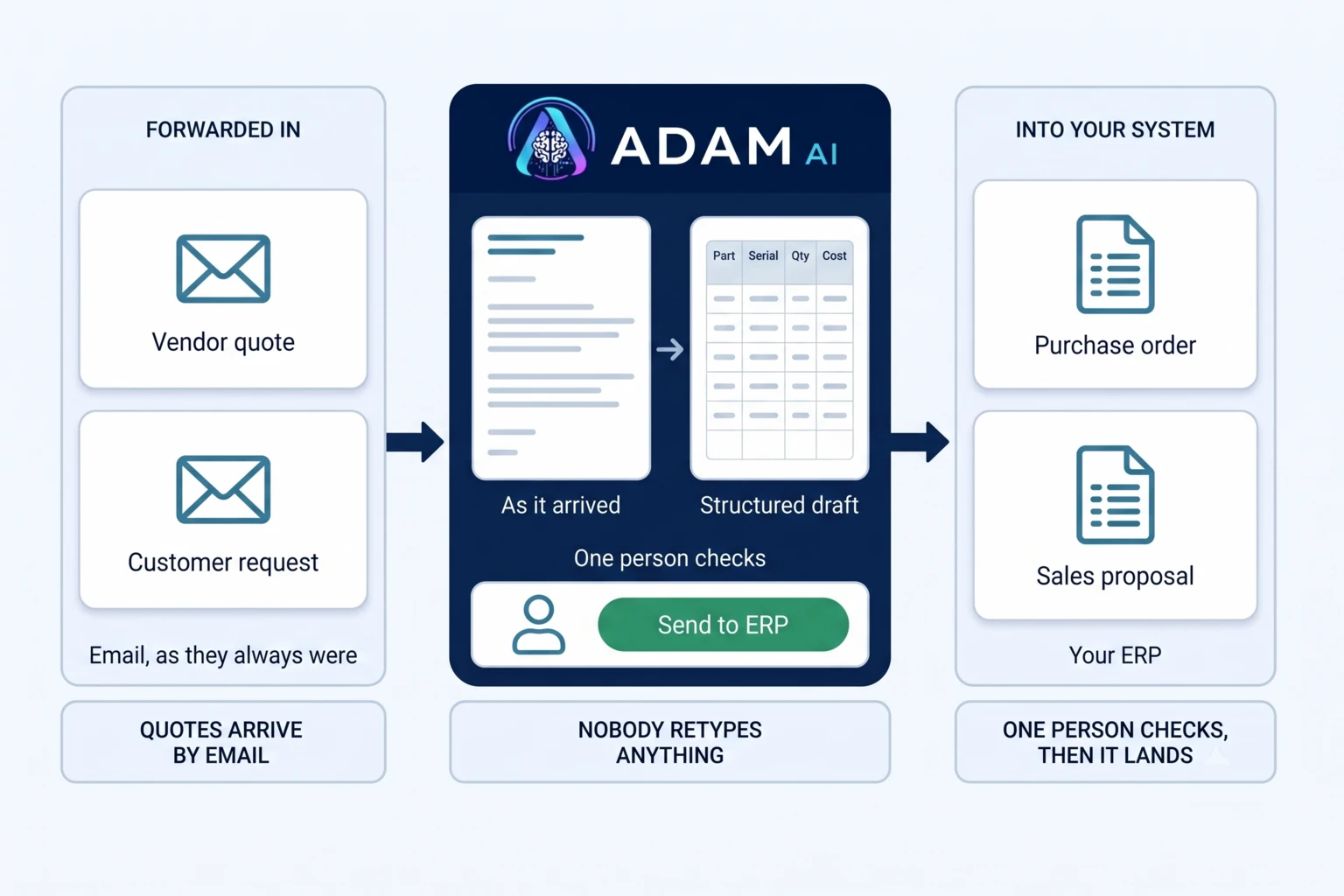
How ADAM turns a forwarded quote into a record
The workflow keeps uncertainty visible instead of resolving it quietly. A message that cannot be attributed waits for a person, a part that cannot be found is not invented, and the write into your own system happens only when someone decides it should.
Quotes arrive by email, not by upload
A vendor quote or customer request is forwarded to an address ADAM watches, and it is attached to the right draft. A message ADAM cannot attribute is held as an open exception for a person to assign, never attached to a best guess.
Every line is resolved against your own catalogue
ADAM looks each part up in the catalogue your system already holds and returns one of five answers: matched, several candidates, absent, unreadable or blank. Each answer leads somewhere different, so no line is quietly dropped.
Prices are benchmarked against your own history
Each line is compared with what your organisation has paid for that part before, and the benchmark travels with the line. The person approving sees whether a quoted price sits inside your normal range without opening a second system.
One person sends it, and only once
A draft is pushed only when it is still a draft, a person has marked it to send, and it has not been pushed before. That third condition is what makes a double click, or a retried job, safe.
An unreadable catalogue is not an empty catalogue
When a catalogue lookup fails, ADAM marks that line unreadable rather than absent. The distinction matters: absent invites the obvious next action, which is to create the part, and a part created twice stays duplicated in your catalogue forever. A transient failure in your own system must never be able to trigger that. The same caution applies to naming, since a quote often writes a part number with a trailing character your catalogue does not store, so ADAM re-queries the normalised form before it calls anything missing. The engine underneath is the same one that will match delivery notes to invoices in any industry, applied here to a quote line rather than a delivery line.
Hardware distribution FAQ
What happens to a forwarded email ADAM cannot attribute?
It is held as an open intake exception rather than attached to a best guess. A person assigns it from a queue, so an unattributed message stays a visible task instead of becoming a mail that quietly went nowhere.
How does ADAM know whether a quoted price is reasonable?
It compares the line against what your organisation has paid for the same part before, and carries that benchmark onto the draft. The benchmark is advisory: it informs the person approving the draft rather than blocking the quote or rewriting the price.
Part numbers in a quote rarely match our catalogue exactly. Does that break the match?
No. Quotes often write a part number with punctuation or a trailing character the catalogue does not store. ADAM queries the catalogue with the number as written, then again with a normalised form, and calls a part absent only when both queries miss. That order stops a naming difference from being mistaken for a missing part.
Can ADAM write a purchase order into our system without a person approving it?
No. ADAM reads, resolves and drafts, but a draft is pushed only after a person marks it to send. The final write is deliberately a human action, because a posted purchase order in a system of record cannot simply be unposted.
Does ADAM produce a purchase order or a sales proposal?
Either, depending on the direction of the transaction. Both are prepared in your own system of record with the resolved lines and pricing already filled in. A sales proposal additionally cannot be sent while any line on it is still unpriced.
What stops the same draft reaching our system twice?
A draft carries a reference once it has been pushed, and a draft that already has one is no longer eligible to push. A duplicate click, a retried job or a second scheduled run therefore cannot create a second purchase order from the same draft.