Billing operations
Count each call once.
ADAM removes duplicate call detail records (CDRs) before calculating the expected bill.
Clean call records before totals are built.

ADAM rebuilds an expected bill from call records, compares it with vendor invoices, and checks realised rates by destination and route.
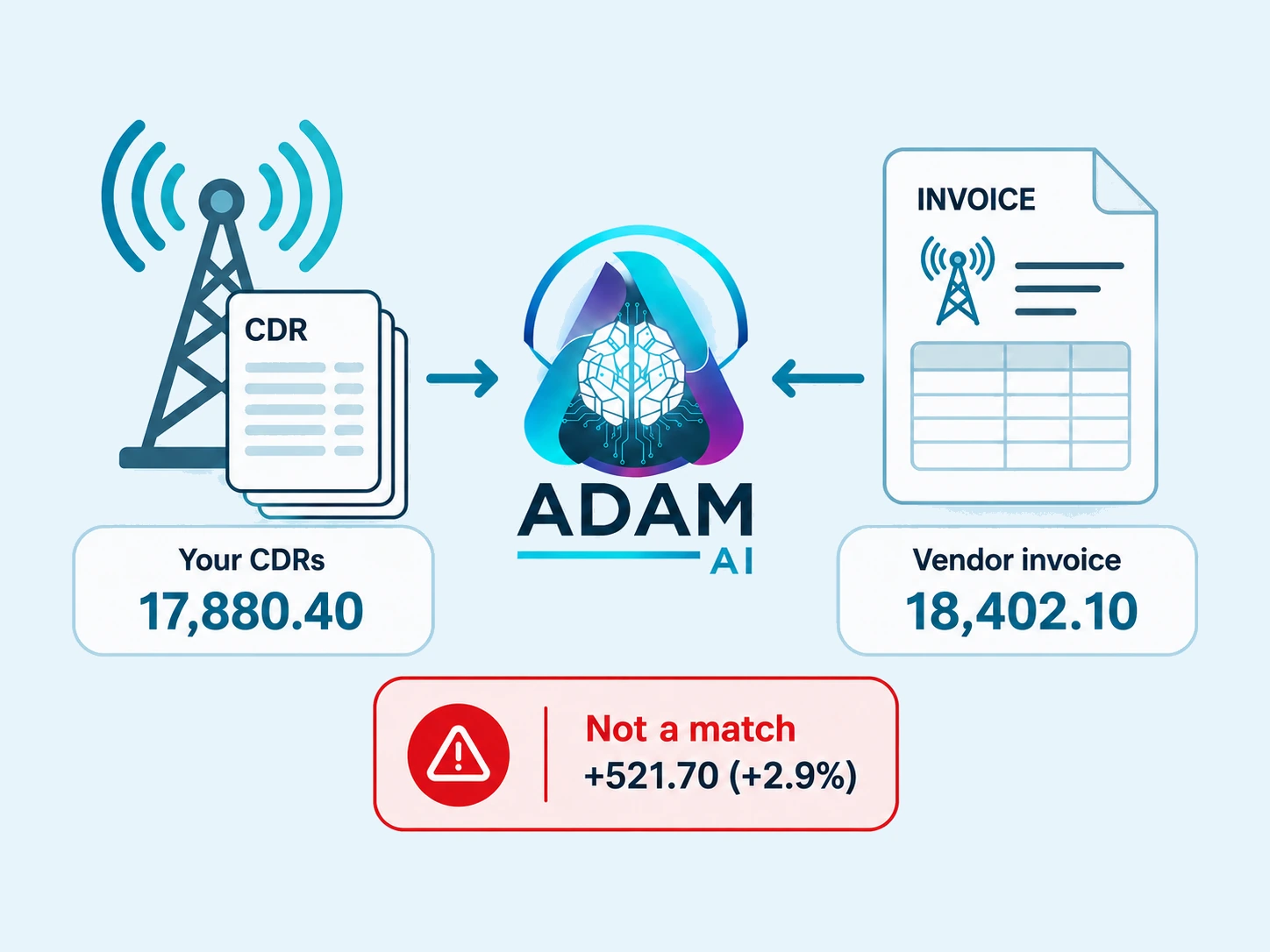
Start with the recorded traffic. Call records are deduplicated before being aggregated. Build an independent expected total. ADAM reconstructs the bill from the traffic: CHF 17,880.40. See the gap against the carrier invoice. CHF 18,402.10 billed. Dispute treatment depends on both configured thresholds.
ADAM compares the invoice against the expected bill for the vendor and billing period.
Contracted and realised rates are checked by destination and route, separately from invoice-total comparison.
Both the configured percentage threshold and the absolute monetary floor must be exceeded for a discrepancy to become a dispute.
Clean traffic, an independent total and rate evidence for your team.
ADAM removes duplicate call detail records (CDRs) before calculating the expected bill.
ADAM reads vendor invoices and extracts the invoice number, dates, amounts and line items, ready to compare with your call records.
A separate check compares contracted and realised rates by destination and route, with evidence your team can investigate.
Showing Billing operations, 1 of 3.
The complete telecom workflow with ADAM AI, connected from start to finish.
Collect and standardize supplier rate lists.
Combine quality history with automated route tests.
Choose routes by cost and quality. Apply margin rules.
Set customer prices and send target rates to vendors.
Import and deduplicate call details from connected telecom systems.
Apply buy and sell rates to each call.
Create and email invoices with usage details.
Match invoices to call records and prepare disputes.
Offset eligible buy and sell balances per partner.
Project incoming and outgoing cash flow by due date.
Send overdue reminders and refresh the forecast.
Match payments, update balances, and close settled items.
The same call can appear again in consecutive hourly CDR files. ADAM streams those files and uses the call reference to remove the repeat before aggregating minutes and amounts, so the daily traffic figure is based on each call once.
ADAM builds its own daily expected bill for each vendor account and jurisdiction from the deduplicated traffic itself, rather than copying the amount from the vendor invoice. That gives the match an expected figure the vendor did not supply.
Only when the configured percentage threshold and absolute monetary floor are both exceeded. Requiring both keeps a high percentage on a tiny amount and a tiny percentage on a large amount from being treated as the same kind of exception.
ADAM first uses an exact document-number match when one exists. The second stage groups candidates by supplier-name tokens, currency and month, then requires the same currency, at least one shared name token and overlapping periods before a candidate can match.
ADAM mirrors the result to Google Sheets, tints the variance red when the billed amount is too high and green when it is too low, and adds a plain-language note to each row. A scheduled digest summarises the resulting review work.
Yes. Instead of rebuilding the expected bill from call records, ADAM can pull the expected amounts a carrier's own billing platform already holds, over a nightly API pull, and match the invoice against those. The comparison is the same, per vendor and billing period, and the same two thresholds decide whether a variance becomes a dispute.
Try the extracted result, then talk to us about the checks and connections your team needs.
Start with the channels you already use. We map the documents, define the modules and connect the outputs to your existing team.